Why is now the tipping point?
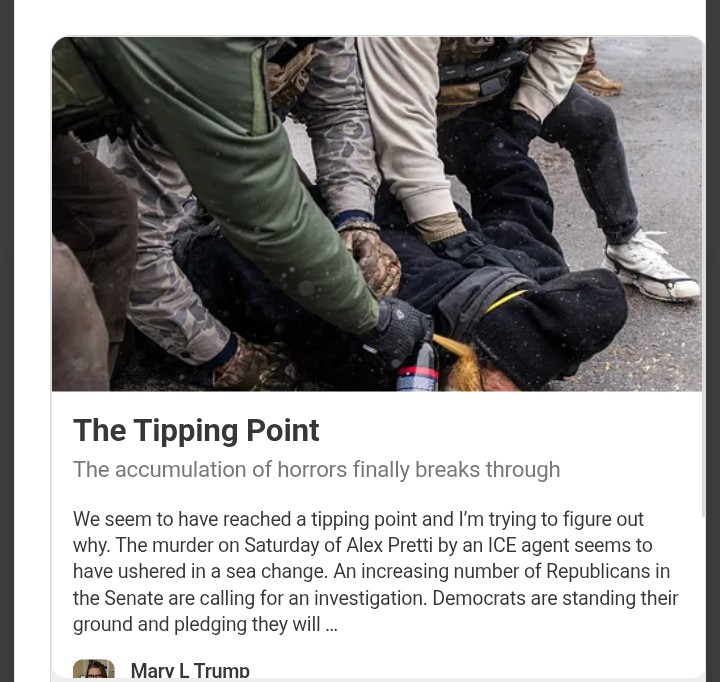
https://www.marytrump.org/p/the-tipping-point
Dear Mary,
Your piece names the question precisely: why this moment, when so many others passed without consequence?
I think the answer is not outrage, or conscience, or even morality. We have had all of those in surplus for years. What finally broke was narrative containment.
For a long time, the system survived by keeping each horror discrete. One abuse replaced the last. Media cycles churned. Courts delayed. Institutions normalized. Nothing accumulated. Cruelty functioned like noise, not evidence. Trump’s particular talent was learning how to make nothing add up.
Minneapolis disrupted that mechanism.
Alex Pretti’s murder crossed an identity firewall many Americans did not know they were relying on. He was a citizen. White. Armed legally. Acting protectively. Shot in the back. In a single act, the patriarchal promise collapsed: that masculinity, legality, obedience, and proximity to power confer safety.
That promise is the core lie patriarchy sells. Not that it protects everyone, but that it protects its men if they comply.
At the same time, the violence became unmistakably federal and unmistakably visual. Masked agents. Heavy weapons. Anonymous force. No bureaucratic abstraction. ICE stopped being a policy argument and became an occupying aesthetic.
What truly broke the spell was documentation.
This time, the violence was not rumored, summarized, or laundered through official language. It was filmed. From multiple angles. In real time. Circulated globally. Lies that have been told for years were proven to be lies. There was no room left for spin to hide.
And all of it was paid for by the public.
These agents, their weapons, their vehicles, their tear gas, their overtime, their impunity—every bit of it funded by taxpayer dollars. Our money was used to terrorize citizens exercising constitutional rights. The state did not merely fail its people; it billed them for the privilege.
The press, confronted with unambiguous evidence, was largely missing in action. Institutions that claim to arbitrate truth hesitated, minimized, or looked away, even as the footage spoke for itself. That absence mattered. It clarified that there is no referee left on the field.
Unlike the slow, normalized genocide of women in this country—diffuse, privatized, dismissed, or buried in statistics—this violence was seen. Everyone saw it. Americans saw it. The world saw it. The brutality did not occur in the shadows where patriarchy usually does its most efficient work.
Then came the rupture propaganda could not survive: contrast.
Federal agents brutalizing protestors while National Guard members in reflective vests protected them. In one visual juxtaposition, the lie collapsed. The federal government looked like an occupying force. The state looked like public servants. Image defeated narrative.
What finally emerged was accumulation. Children terrorized. Protestors brutalized. Citizens hunted. A man murdered. And all of it recorded. For once, the horrors stacked instead of replacing one another. People could see the throughline. Not scandals. A regime logic.
This is where patriarchy’s levers become visible.
Its power rests on fear, fragmentation, identity hierarchies, exhaustion, and invisibility. It depends on lies remaining plausible, on the worthy not being rewarded, on the public believing there is still law and order somewhere above the chaos—even as their own money is used to dismantle it.
Minneapolis shattered that belief. The lies were exposed. The press failed. The deserving were not protected. And it became impossible to pretend that law and order still exist as principles rather than slogans.
Even Republican reactions make sense in this light. They are not acts of conscience. They are acts of fear. Fear of losing narrative control, plausible cover, and voter complacency. Patriarchal systems do not fall because people become good. They falter when recognition spreads faster than suppression.
So I don’t think justice has arrived. I don’t think accountability is coming in any satisfying form. But I do think an illusion failed: the illusion that the violence has limits, that the system self-corrects, that truth is enforced, that the law still functions, that it cannot happen to “you.”
Resistance does not need better outrage. It needs visibility, accumulation, solidarity across the identity firewall, and refusal to let horrors be reset to zero.
Once recognition spreads, outrage becomes action-capable. And recognition, unlike outrage, is very hard to erase.
With appreciation for your clarity and persistence,
Jodi




Comments ()