
When Civic Institutions Fail the Women Who Built Them
Civic Pride Is Easy. Civic Responsibility Is Not.
I’m sitting in the San Rafael Public Library, under a plaque that commemorates its founding. It lists sixty-one residents of San Rafael and Andrew Carnegie — citizens who believed a library was a public good worth building together.
I pause longer than most people do.
Because my name is on a wall like that, too.
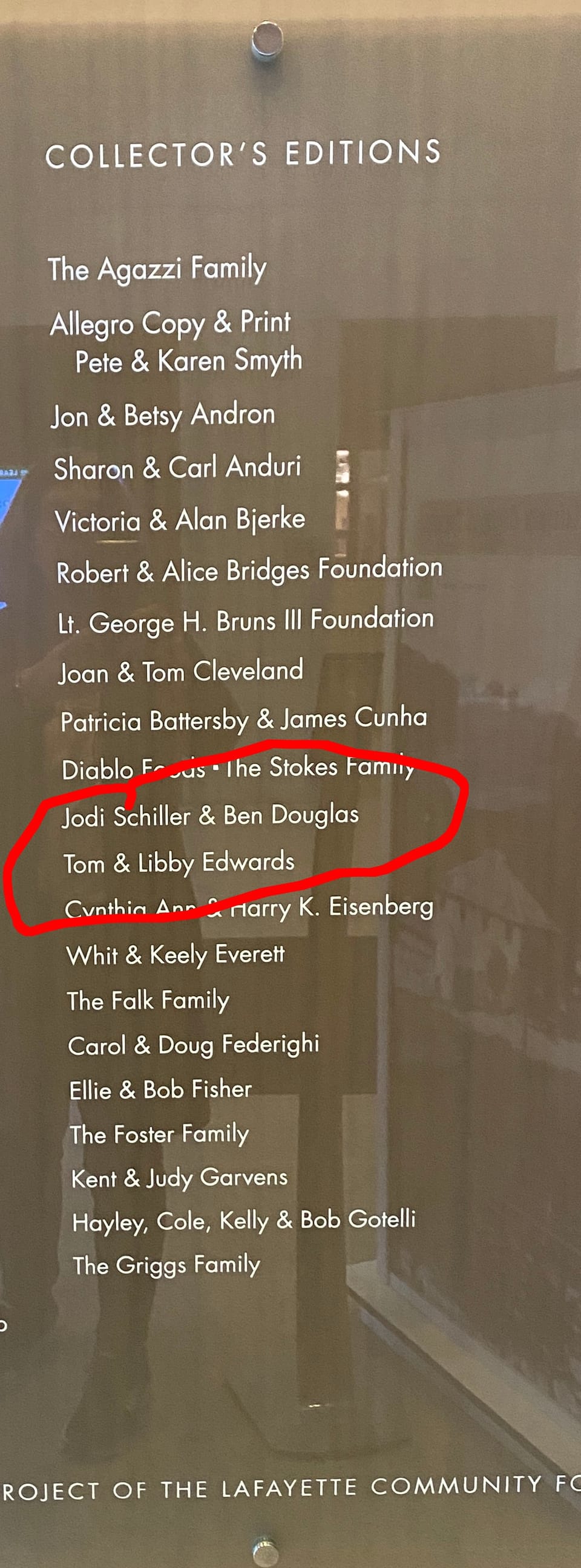
Years ago, when I lived in Lafayette, I helped build the Lafayette Library. I was a significant founding donor. My name is mounted in the front lobby alongside others who made the building possible. The structure is beautiful — light-filled, deliberate, proud of itself. A civic promise made of glass and wood.
And yet, I cannot safely enter that library.
I don’t use it. I can’t.
Not because I don’t love libraries — I’m sitting in one now — but because returning to Lafayette would mean returning to a place where the law has functionally erased me.
My ex-husband still occupies the house that was legally mine. He remains there despite massive unresolved financial wrongdoing. Despite debts measured not in inconvenience, but in the tens of millions. Despite the fact that I am the injured party.
Instead of protection, I was met with exclusion.
Instead of restoration, I was met with restraint.
A restraining order was issued that prevented me from returning — not the person who benefited from the harm, but the person who lost her home, her safety, her footing. Law enforcement did not intervene to restore balance. Local institutions did not step in to correct the injustice.
The system didn’t malfunction.
It aligned — just not with the person it should have protected.
And so the result is this quiet absurdity:
I helped build a public institution dedicated to access, learning, and refuge. My name is permanently displayed in its front lobby.
And I am effectively barred from it.
My name is on the wall.
My body is elsewhere.
This is what institutional failure looks like when it wears a polite face.
When the buildings are beautiful.
The plaques are engraved.
And the harm happens offstage — in paperwork, in silence, in “we can’t help you with that.”
Libraries are meant to be sanctuaries. They represent a belief that knowledge should be shared, that citizens matter, that communities invest in one another across generations.
But a society does not get to congratulate itself for its civic values while quietly dispossessing the very people who helped build them.
What does it mean when the benefactors of public goods are rendered homeless by private injustice and public indifference?
What does it mean when the law protects occupation over ownership, control over truth, convenience over harm?
I don’t tell this story because it is unique.
I tell it because it isn’t.
Many people walk past plaques every day without realizing that some of the names etched into stone now belong to people pushed to the margins — not because they failed, but because the system failed them and then refused to correct itself.
So I sit in San Rafael’s library instead. Grateful for the warmth, the quiet, the shelves. Thinking about how easily civic pride obscures civic responsibility.
This is not an abstract failure. It is a concrete one — experienced in Lafayette, California — where institutions that benefited from my contribution have remained silent as I was excluded from protection.
A library can be built by a town.
Justice requires more.
And a name on the wall means very little if the person it belongs to is no longer protected by the society she helped sustain.

Comments ()