What Happens When Restraint Is Treated as Weakness
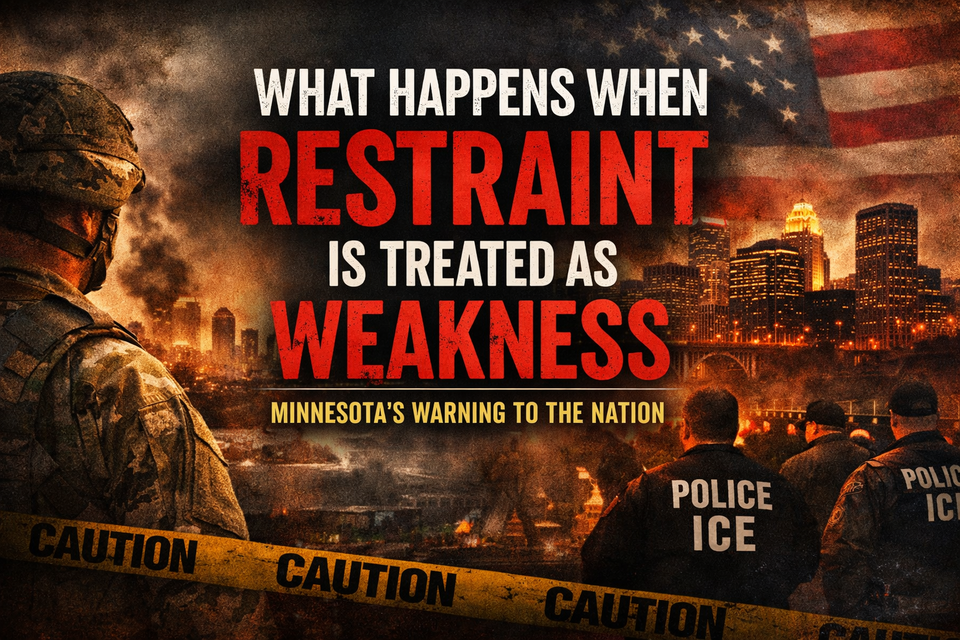
In Minneapolis this month, federal immigration agents fatally shot two U.S. citizens — Renée Good and Alex Pretti — in controversial encounters that have ignited widespread protests, legal challenges, and political conflict. (en.wikipedia.org)
Minnesota’s response has been measured: the National Guard was activated to assist local law enforcement, protests have remained largely nonviolent, and state political leaders have demanded accountability rather than retaliation. Citizens, including veterans and armed residents, stayed restrained, watching and waiting. (aljazeera.com)
Restraint worked. But the question hanging in the air is simple: how long before it stops working?
History is clear. Every time a population holds its temper while authority acts with impunity, every time a community absorbs harm while waiting for justice, the system grows weaker. The longer silence is mistaken for consent, the closer everyone edges toward a breaking point.
Veterans and other disciplined citizens understand the calculus. They know what happens when force is misused. They know the costs of escalation — for civilians first, for power second. That knowledge is why threats are quiet, not absent. That knowledge is why restraint in Minnesota is currently the only thing keeping the situation from spinning out.
Then came a development that crystallized exactly how deep the crisis has become.
U.S. Attorney General Pam Bondi sent Minnesota Governor Tim Walz a letter outlining specific conditions she said would “restore the rule of law” and potentially reduce the federal presence of U.S. Immigration and Customs Enforcement (ICE) agents in the state. The demands were extraordinary: Minnesota would have to provide access to its voter rolls, share welfare and public assistance data, and repeal sanctuary policies before the federal enforcement presence might ease. (people.com)
To many Minnesotans — and observers nationwide — this looked less like a public-safety strategy and more like political leverage. State officials, including the Minnesota Secretary of State, called the request to hand over voter data “an outrageous attempt to coerce Minnesota into giving the federal government private data on millions of U.S. citizens in violation of state and federal law.” (kttc.com)
Bondi’s letter was issued in a climate of heightened federal rhetoric, where authorities repeatedly warn that they are defending against all threats, foreign and domestic. The implication is stark: restraint and law-abiding caution could be interpreted as potential danger if federal power goes unchecked. That’s not law enforcement. That’s leverage disguised as authority.
The Second Amendment, stripped of mythology, was never designed as a street-level instruction manual. It was a deterrence framework — a structural reminder embedded in the architecture of the nation that legitimacy matters, and that force without consent corrodes the state itself.
Its power was always meant to be latent.
When deterrence works, nothing happens.
No shots fired. No martyrs crowned. Just restraint, because everyone understands the cost of crossing the line.
The danger begins when restraint is mistaken for weakness.
When silence is treated as consent.
When grief is treated as compliance.
When lawful outrage is treated as sedition.
That’s when people begin asking questions no healthy society should be forced to ask.
You won’t see active threats in Minnesota right now because people who know the consequences avoid announcing intent. Threats invite preemption. Preemption invites escalation. Escalation justifies repression.
Anyone with lived experience understands that open threats don’t protect communities. They destroy them.
What you see instead is containment. People holding themselves in check. People thinking about families, neighbors, and lines that cannot be uncrossed without burning the future.
This is not cowardice. It’s moral weight.
The real risk in Minnesota is not secret plotting. It’s institutional arrogance — the assumption that restraint is infinite, that legitimacy can be stretched without repair, and that disciplined silence will absorb anything thrown at it.
History offers no comfort on that bet.
Societies don’t collapse because citizens speak too loudly.
They collapse because power stops listening while there is still time.
Minnesota’s silence is not a lull.
It’s a line.
And the country would do well to respect it.
Short Kicker
When political leverage replaces accountability, restraint no longer protects peace — it signals fragility. Minnesota’s quiet is not weakness. It’s the last barrier before chaos. (people.com)



Comments ()