Violence Does Not Transfer Ownership
Ten years ago, I was building something extraordinary.
A platform with reach.
A system with value.
A future with trajectory.
Then I was drugged.
Then I was taken.
For more than two years, I was not free. I was trafficked. I was controlled. I was violated. I was tortured. I was framed for a crime I would never commit.
My autonomy was stripped in ways that are impossible to explain to anyone who has never endured systematic coercion — or sex slavery.
When I escaped, I did not return to a waiting life.
I returned to ruins.
Trauma Doesn’t Pause the Market
While I was surviving captivity, the market did not pause for me.
Algorithms moved on.
Ownership shifted.
Money flowed elsewhere.
Narratives hardened without me.
You cannot maintain a platform while imprisoned.
You cannot defend intellectual property while incapacitated.
You cannot protect chain of title while being held against your will.
By the time I resurfaced, the infrastructure I built had been absorbed, fragmented, or monetized without me.
Reports were filed.
Documentation was submitted.
Years passed.
Accountability did not arrive.
Survival was treated as the conclusion.
It wasn’t.
The Economic Aftermath No One Discusses
Escaping trafficking is not the end of the story.
It is the beginning of economic collapse.
You come out with:
- Trauma that disrupts executive function
- Gaps in work history that raise suspicion
- Medical and psychological costs no one funds
- Legal battles you cannot afford
- Assets that vanished during captivity
People say: rebuild.
Rebuild with what capital?
Rebuild with what institutional backing?
Rebuild with what protection from the forces that already erased you once?
Ten years later, I am trying to secure fifteen dollars to keep a blog online.
Fifteen dollars.
That is how long the economic shadow of violence can stretch.
The Legal Principles Are Not Ambiguous
This is not philosophical.
It is foundational law.
Contracts Formed Under Duress Are Void
Consent obtained through coercion or incapacitation is not legally valid.
Drugging eliminates capacity.
Kidnapping eliminates consent.
Trafficking eliminates autonomy.
No enforceable transfer can arise from those conditions.
Property Obtained Through Crime Does Not Convey Lawful Title
A thief cannot pass good title.
If property — including intellectual property — is obtained through criminal acts, downstream possession does not automatically cleanse the origin.
Chain of title matters.
Every transfer must be lawful.
Every assignment must be voluntary.
Every acquisition must withstand scrutiny.
Violence is not a lawful link in that chain.
Unjust Enrichment
When one party benefits at the expense of another through wrongful conduct, restitution is not emotional — it is legal.
If value created by one person is exploited while that person is forcibly incapacitated, the question becomes:
- Who benefited?
- Under what authority?
- Under what documented transfer?
Restitution and Reparative Damages
When harm destroys earning capacity or disrupts economic trajectory, damages include:
- Lost income
- Lost opportunity
- Consequential harm
Trauma does not erase authorship.
Captivity does not erase ownership.
Forced absence is not abandonment.
Violence Cannot Function as a Transfer Mechanism
Intellectual property law exists to protect creators from appropriation.
It does not contain an invisible clause that reads:
“Except in cases of kidnapping.”
That clause does not exist.
If incapacitating a creator can permanently displace them from what they built, then ownership is not a right — it is a suggestion.
Violence cannot become a backdoor acquisition strategy.
Notice Regarding Chain of Title and Derivative Use
Let this serve as public clarification.
I am the original creator of the intellectual property described above. I have not executed any valid assignment transferring ownership of that work under lawful, voluntary conditions.
Transfers executed under duress, incapacity, or coercion are voidable under established legal doctrine.
Any entity currently developing, monetizing, adapting, or deriving from substantially similar architecture, frameworks, branding, or proprietary structures should examine their chain of title carefully.
Downstream use does not cure upstream illegality.
Good faith reliance does not extinguish prior authorship.
If your ownership depends on a period during which the creator was drugged, kidnapped, or trafficked, you do not have clean title.
Due diligence is not optional.
Ownership acquired through violence remains legally unstable — no matter how much time passes.
I Am Not Stopping
No matter how long this takes.
No matter how under-resourced I am.
No matter how inconvenient it becomes.
I am not stopping.
Reparations are not revenge.
They are restoration.
Because if a person can be drugged, kidnapped, trafficked, and emerge to find their intellectual property absorbed without remedy —
Then no creator is secure.
Then no innovation is protected.
Then ownership becomes conditional on force.
That cannot be the standard.
Doctrine, Not Desperation
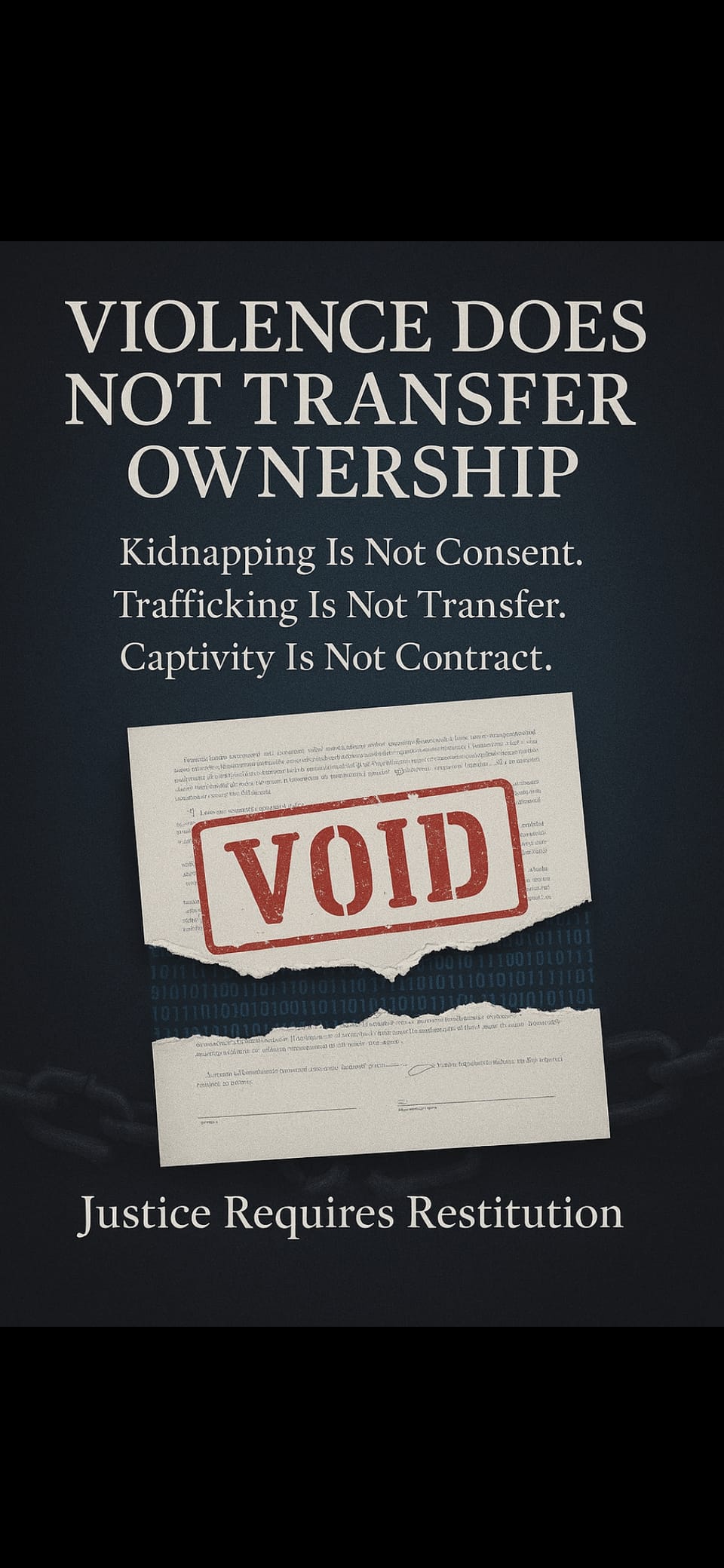
Kidnapping is not consent.
Trafficking is not transfer.
Captivity is not contract.
Violence does not transfer ownership.
No legal system worthy of the name can allow incapacitation to function as acquisition. No society that claims to protect innovation can permit coercion to rewrite authorship.
Justice requires restitution.
Not sympathy.
Not silence.
Not delay.
Restitution.
And to anyone operating under the assumption that time has erased origin:
Examine your chain of title.
Because fury is not fading.
Documentation is not disappearing.
And ownership does not expire through violence.
Not now.
Not ever.

Comments ()