The Thought Bubble They Fear More Than Rape
Tone-Policing in a World of Violence Against Women
How Puny Little Man Kings Hate When Women Tell the Truth
I recently ran into a familiar wall. Not a legal one. Not a factual one. A tonal one.
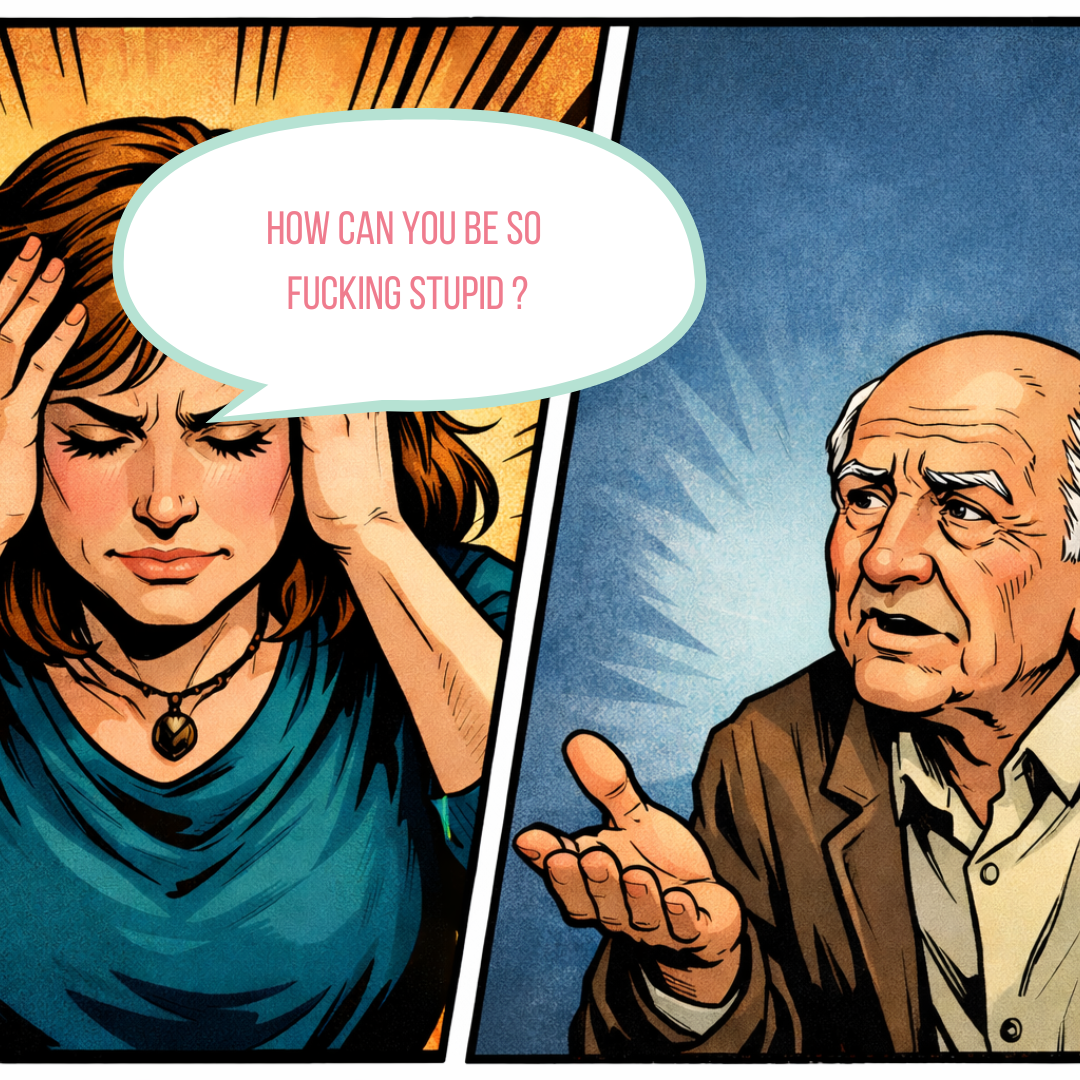
I tried to put a thought bubble over a cartoon: a woman holding her head in disbelief, facing an older man. The image is simple and familiar — her posture telegraphing exhaustion, his presence representing yet another authority figure who does not understand what is plainly in front of him.
The thought bubble would have read something like:
How can you be so stupid?
That, apparently, was too much.
The system I was using wouldn’t even generate the image. An error message appeared instead, informing me that the request crossed content boundaries — that it violated standards around harassment or abuse. The cartoon could not be created as imagined, not because it depicted violence, but because it named frustration too directly.
Too harsh.
Too insulting.
Too far.
And yet we live in a world where men can rape, torture, and murder girls and women — often with impunity, often with institutional cover, often after long, documented patterns of abuse — and the systems designed to moderate harm barely stir.
This is not a contradiction.
It is a design choice.
What Gets Policed vs. What Gets Permitted
We like to pretend our systems are about preventing harm.
They are not. They are about preventing disruption.
Actual violence is slow, bureaucratic, and easily buried in procedure. It can be “investigated.” It can be “contextualized.” It can be delayed until public attention moves on.
Language, on the other hand, is fast. It spreads. It punctures. It names things plainly.
So language gets policed.
A sharp sentence is easier to flag than a powerful man. A woman’s anger is easier to suppress than a man’s brutality. Tone is safer to regulate than power.
The Lie of Civility
We are told that civility is the price of participation. That if we just speak more gently, more kindly, more patiently, the truth will be heard.
This is a lie.
Civility has never been evenly enforced. It is demanded almost exclusively from those without power, while those with power violate every moral boundary imaginable and are still granted platforms, defenses, and second chances.
Civility is not about respect.
It is about containment.
Why Anger Is Treated as the Problem
Anger exposes gaps. It reveals the distance between rhetoric and reality. It asks why obvious patterns must be explained endlessly to people who suffer no consequences for misunderstanding them.
That kind of anger is dangerous — not because it harms, but because it clarifies.
So it is reframed as inappropriate. Unproductive. Divisive.
Meanwhile, the violence that caused the anger is treated as complex.
Silence Does the Work
In the end, the cartoon did not need the thought bubble.
The image already said everything: the posture, the hands at the temples, the exhaustion of explaining the obvious — again — to someone insulated from consequence.
Silence, it turns out, can say what language is forbidden from saying aloud.
Artists and truth-tellers have always known this. When the rules punish direct speech, meaning moves sideways — into metaphor, irony, implication.
Not because the truth is unclear, but because the system cannot tolerate it spoken plainly.
This Is Not Neutral
None of this is accidental. It is not about safety. It is about stability — preserving existing hierarchies by disciplining the people who challenge them, not the people who harm others.
If a cartoon thought bubble is treated as more dangerous than real-world violence, that tells us exactly what the system is protecting.
And it is not us.
The image above is not violent. It is diagnostic. A woman holding her head, an older man still centered, and a sentence that finally says what the posture already tells you.
If this is what gets flagged, then the problem is not the words.
It is who is allowed to speak them.

Comments ()