The Script of Subjugation: Why Hollywood Fears the Library The Evidence on the Shelf
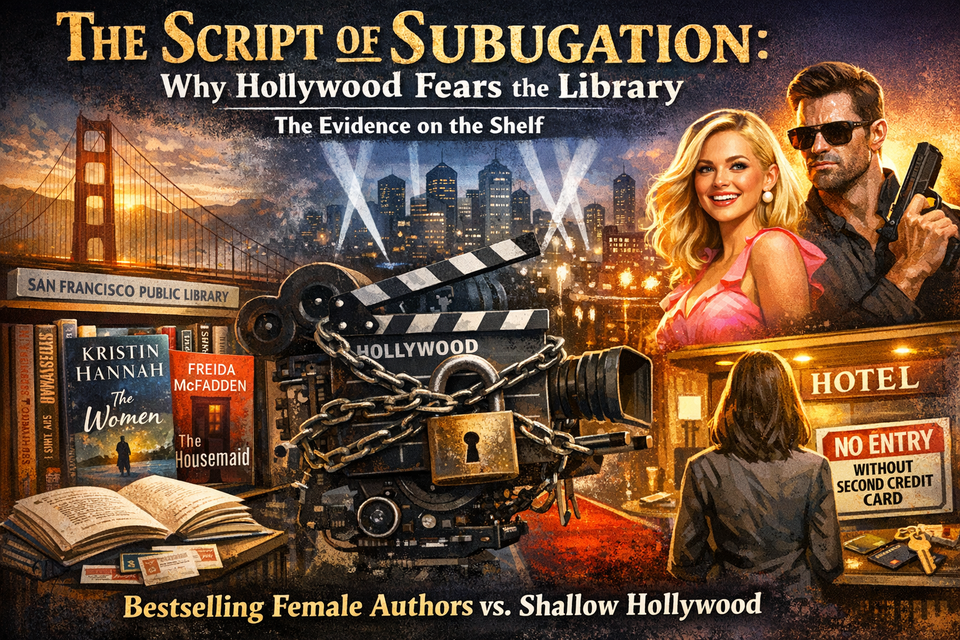
The Script of Subjugation: Why Hollywood Fears the Library
The Evidence on the Shelf
In San Francisco, the data doesn't lie. For the past two years, the "Most Borrowed" lists at the public library have been a wall of female names. The people have spoken: they want stories of female agency, complex survival, and the dismantling of old myths. From Kristin Hannah’s The Women to the psychological thrillers of Freida McFadden, the public is "voting" with their time and their library cards.
Yet, as we look at the Hollywood production slates for 2026, these community-validated hits are nowhere to be found. This isn't a "market oversight." It is narrative control.
The Cult of Shallowness and the Death of the Stage
When we look at the movies and TV shows actually being produced, the contrast is staggering. While library patrons are diving into deep, multifaceted narratives, the screens are filled with content that is increasingly shallow. This superficiality is a choice. Shallow stories are easier to control; they avoid the messy, visceral realities of female life and systemic struggle.
This rot extends to the theater. For those of us in the theater world, the "new" season is a graveyard of originality. There is no new good theater; it is all the same recycled material, the same safe revivals, and the same hollow spectacles. By starving new, original plays of funding and stage time, the industry ensures that the "live" experience remains a museum of the past rather than a mirror of the present.
The "Barbie" Proof and the Profitable Lie
Hollywood often hides behind the excuse of "marketability," but Barbie shattered that shield. With a $1.45 billion box office, it proved that the female perspective is the most powerful economic force in entertainment. By ignoring the Top 10 books in favor of male-led sequels and shallow reboots that consistently underperform, the industry reveals its true priority: They would rather lose money on a male narrative than make a profit on a female one. ### Brutal Subjugation through Financial Gatekeeping Narrative control requires physical and financial control. The industry ensures its "walls" remain high by using logistical traps to filter out independent women. We see this most clearly in predatory hotel and travel policies. * The "Second Card" Trap: Even when a third party has paid for a room and incidentals, hotels often demand a second personal credit card from the guest.
- The Goal of the Barrier: This isn't about safety; it’s about financial policing. It ensures that a woman without a traditional patriarchal "safety net" or significant personal credit cannot stay in the room, attend the meeting, or film the scene.
By making the simple act of checking into a hotel a humiliating financial hurdle, the industry ensures that only those who "fit" the established power structure can survive the journey.
The Architecture of Fear
Brutal subjugation starts with narrative control. If the industry allows the stories women are actually reading to become the "universal" stories of our time, the patriarchal hierarchy loses its grip. They don't hate these books because they are "niche"; they hate them because they are evidence of a world where men are no longer the default protagonists of history.
The industry is not "slow to change"—it is the architect of a system designed to keep women as "guests" in their own culture, requiring a "co-signer" just to exist in the industry’s space.
The Awakening: A Call to Action
The millions of library holds on these books represent an army of women who see the man behind the curtain. We see the fear in the boardroom. We see the financial sabotage at the hotel desk. And we see that the refusal to adapt our stories—on screen or on stage—is the ultimate admission that they have already lost the argument.
We see the laws deliberately set up to keep us trapped in slavery. We see how our money, our time, and our value are being stolen to feed a machine that works against us. We see all of it—the recycled plays, the shallow shows, the financial traps—and we are going to act on it. The narrative is no longer theirs to write.

Comments ()