
The Patriarchy as Infantile Object Relations Gone Mad

When we critique patriarchy, we often start with laws, economics, or institutions. These analyses are necessary but incomplete. To understand patriarchy’s emotional logic—its rigidity, intolerance of complexity, and obsession with control—we must look deeper, into the earliest chapters of human development. There we find the building blocks of the psyche itself.
Object Relations: The Emotional Architecture of the Psyche
Object relations theory, a major school of psychoanalytic thought, proposes that the human psyche is structured by our earliest emotional relationships with caregivers, especially during full dependence in infancy. The “objects” are not material things but internalized representations of people—first and foremost the caregiver, and even parts of them, like the breast—which shape identity and emotional expectations throughout life.
Foundational texts by Greenberg and Mitchell show how these internal object representations form the basis of personality and relational patterns in adulthood.
Infantile Emotions Are Binary: Safety or Terror
In early infancy, emotion is black-and-white. There is no “mixed feeling,” no internal duality. For the human infant, the emotional world exists in two states only:
Safety
Terror
There is no psychological space for “both,” “neutral,” or “partial.” This is not metaphor—it is a developmental fact. The infant brain is still forming the circuits that allow regulation, integration, and nuanced emotional processing. Until these circuits mature, emotional experience lands at the poles.
Attunement Shapes the Infant Brain
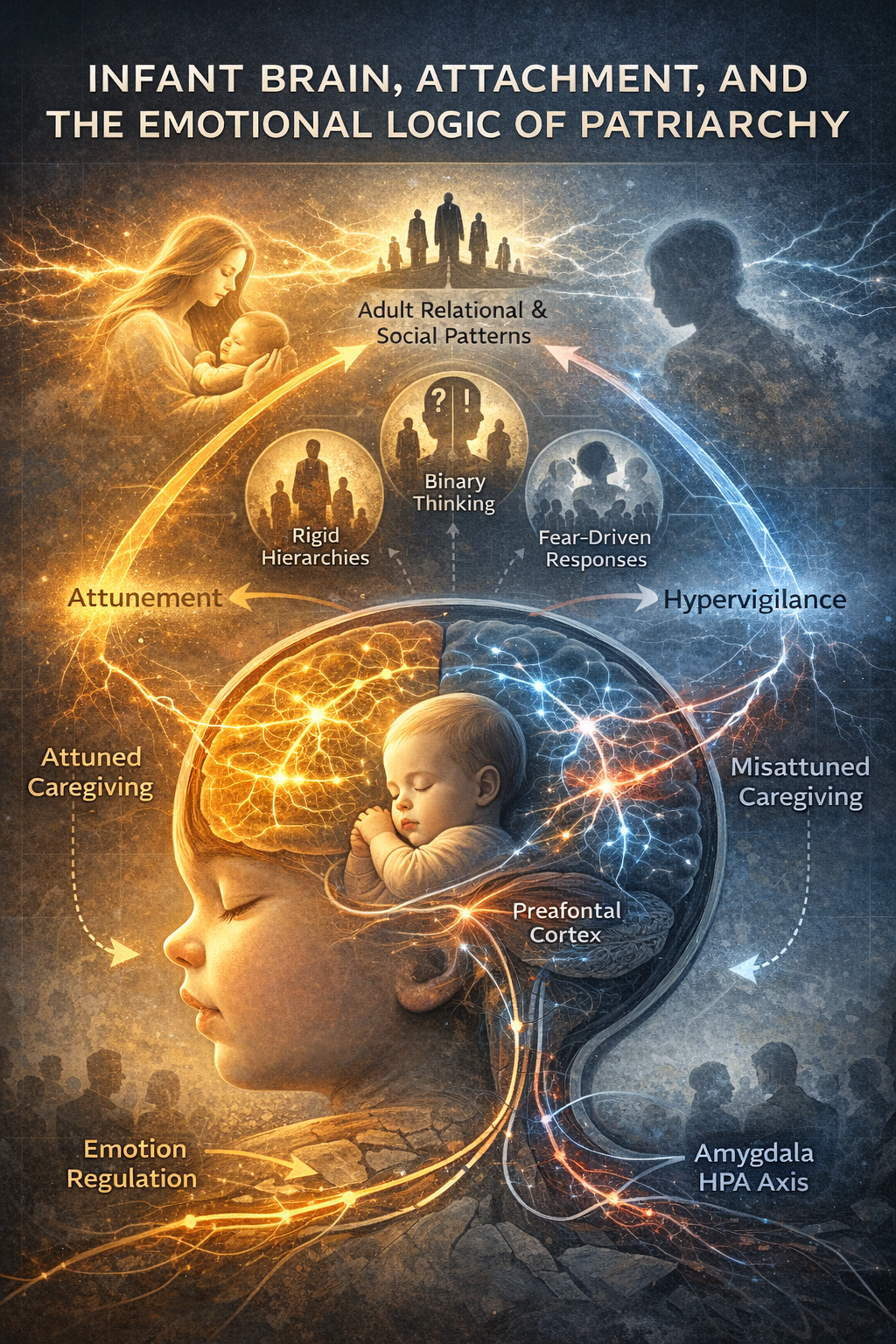
Modern neuroscience confirms that early caregiving literally shapes the brain’s architecture. Sensitive, attuned caregiving—where a caregiver accurately perceives and responds to an infant’s cues—enhances neural circuits in areas linked to emotion regulation, particularly the prefrontal cortex. Experiences of safety build networks that support resilience and flexibility; unsynchronized caregiving disrupts these pathways, making emotional regulation harder later in life.
Face-to-face attunement between infant and caregiver doesn’t just feel comforting—it regulates neurochemical responses, anchors stress systems, and guides the development of the right hemisphere, critical for emotional integration.
Attunement refers to the caregiver’s moment-to-moment responsiveness: reading emotional cues, matching affect, and guiding the infant from distress toward regulation. Repeated patterns of attuned interaction promote healthy synaptic development, especially in regions associated with executive function and emotional integration. Where attunement is absent, misattunement or inconsistency biases the nervous system toward fear and hypervigilance—biases that often persist into adulthood.
Attachment and Maternal Authority
Attachment is not only about food or physical care; it is about safety and emotional regulation. Bowlby framed it as an evolved survival mechanism: infants cling to caregivers to regulate distress, not merely for sustenance.
In object relations and attachment science, maternal authority does not mean control or dominance. It is the caregiver’s consistent capacity to regulate the infant’s distress through co-regulation, attunement, and appropriate boundaries—a secure base. When this authority is present, the infant learns that the world is navigable, that internal distress can be modulated, and that ambiguity does not imply annihilation.
Consequences of Insufficient Maternal Authority
When caregiving is inconsistent, unpredictable, or unavailable during distress, the infant’s nervous system interprets this as danger. Stress networks like the amygdala and HPA axis become hyperactive, while cortical regulatory circuits in the prefrontal cortex underdevelop. This stable neural set point biases the brain toward hyper-vigilance and emotional reactivity throughout life.
Psychologically, inconsistent caregiving prevents the infant from forming a coherent internal model of safety. Instead of integrating “good” and “bad” objects, the infant develops a split system: part fears abandonment, while another oscillates between seeking closeness and rejecting dependency. This splitting inhibits emotional regulation and cognitive flexibility and maps onto adult patterns such as:
Chronic anxiety or hypervigilance
Difficulty tolerating uncertainty
Reactive aggression or withdrawal
All-or-nothing emotional responses
These are not quirks of personality—they reflect neural circuits sculpted by early caregiving.
Healthy maternal authority is regulatory, not controlling. It allows the infant to develop internal flexibility. Insufficient authority primes the brain for threat detection rather than adaptive regulation.
From Individual Neuroscience to Society
If patriarchy is an extension of infantile object relations into social systems, then insufficient maternal authority mirrors a society that has never learned collective regulation. Just as a child defaults to fear-driven strategies when co-regulation fails, a culture with this pattern defaults to:
Authoritarianism instead of mutual accountability
Binary thinking instead of nuanced problem-solving
Dominance as protection rather than collaboration as safety
Insufficient early attunement at the neural level predicts not only individual outcomes but social structures that tolerate only polarized states.
Toward Integration Rather Than Projection
The antidote to terror is not control but regulated presence. The antidote to fragmentation is not dominance but attuned co-regulation. The antidote to binary emotional logic is not rigidity but integration.
Viewed this way, patriarchy is not a rational system of power but a culture stuck in the emotional logic of infancy—terrified of ambiguity, incapable of internal regulation, and reliant on external control to simulate safety.
If adult relational dynamics are shaped by early emotional experiences, patriarchy reflects the persistence of infantile binary logic:
Ambiguity triggers dominance
Complexity is rejected in favor of rigid hierarchies
Fear is projected rather than integrated
This is not mature reasoning but developmental arrest—a social system living in the emotional logic of infancy.
What This Perspective Reveals
Patriarchy is not only a matter of power; it is the projection of early survival strategies onto society. Its insistence on control, dominance, and clear binaries is a macro-scale replay of infantile emotional processing that never matured.
This lens invites new questions:
What if cultures could cultivate collective attunement, not control?
What if emotional regulation and ambiguity tolerance were social capacities, not individual pathologies?
What if the maturation of society mirrored neural maturation?
This is not a rejection of political analysis—it is its expansion. Patriarchy becomes not only a structure of power but a civilization’s unfinished emotional development.
Annotated References (for Publication)
Object Relations Theory (Psychoanalytic Foundations)
Melanie Klein — Foundational Concepts in Infant Emotional Development
Klein’s work established core object relations ideas, including how infants experience internalized “good” and “bad” objects and how early relationships shape psychological structures. Her clinical theory centers on pre‑verbal infant drives and the importance of early bonds with caregivers. �
Simply Psychology
Greenberg & Mitchell — Object Relations in Psychoanalytic Theory
A seminal text in object relations scholarship, synthesizing multiple theorists and articulating how early relational patterns form the structure of the psyche over a lifetime. �
Wikipedia
Daniel N. Stern — The Interpersonal World of the Infant
Stern’s influential developmental account describes how the infant gradually forms integrated senses of self via early relational attunement with caregivers. �
Wikipedia
Attachment Theory and Development (Psychological & Neurobiological Perspectives)
John Bowlby — Attachment Theory (Collected Works / Classic Trilogy)
Bowlby first framed attachment as an evolved biobehavioral system, emphasizing the infant’s drive for safety and connection with a “secure base.” This work bridges psychoanalytic insight with evolutionary biology and early neurodevelopment. �
Social Sci LibreTexts
Mary Ainsworth — Strange Situation and Secure Attachment Patterns
Ainsworth’s empirical work identified attachment patterns (secure, avoidant, resistant, disorganized) through structured observation and is foundational evidence that early caregiving quality predicts social and emotional development. �
PubMed
Neuroscience and Infant Brain Development
The Neurobiology of Attachment: From Infancy to Clinical Outcomes
A review of how early caregiver bonds create long‑lasting changes in neurobiology—impacting stress response systems, emotional regulation, and later mental health (e.g., HPA axis, oxytocin systems). �
PubMed
Attachment in Integrative Neuroscientific Perspective
This article connects attachment behavior with neural structure development, showing how early caregiver interactions influence neural systems underlying emotion, cognition, and social experience. �
PubMed
Neural Representation of Parent‑Child Attachment Across Development
Longitudinal fMRI evidence showing continuity in brain responses to attachment stimuli from infancy through adulthood, highlighting the persistent neural signature of early attachment. �
PubMed
Neurobiology of Infant Attachment and Parental Regulation
Findings reveal that the development of key emotion regulation structures (amygdala, prefrontal cortex) is shaped by early sensitive caregiving and attunement, with profound implications for lifelong emotional functioning. �
PMC
Neural Basis of Attachment‑Caregiving System Interaction
This review explains how reciprocal attachment and caregiving systems co‑activate in infant–caregiver interactions, supporting survival and socio‑emotional development. �
PMC
Complementary and Integrative Texts
Psychobiology of Attachment and Trauma
Explores attachment as a biological principle with evolutionary advantage, linking early caregiving interactions to emotional regulation and future relational capacities. �
Suggested Classic & Contemporary Reads (for Further Depth)
You might also include a brief recommended reading list section in your publication for readers who want to trace the intellectual lineage more deeply:
• Melanie Klein’s collected papers — for original object relations casework and theory.
• Object Relations in Psychoanalytic Theory (Greenberg & Mitchell) — comprehensive overview.
• Daniel Stern’s developmental works — on self‑formation and attunement processes.
• Bowlby’s Attachment Trilogy — classic, theory‑driven foundation of attachment science.
• Contemporary neurobiology reviews on early b
rain development — for empirical grounding of attachment and emotion regulation mechanisms.




Comments ()