
That’s Too Bad: A Field Report on Impunity
I Tell Everyone
I tell everyone.
Everywhere I go, to anyone who will listen, I tell them what happened to me and why I am homeless.
I do not whisper it. I do not soften it. I do not frame it as confusion or misfortune.
I state it plainly:
I was kidnapped.
I was trafficked.
I was tortured.
I was stolen from.
Intellectual property of extraordinary value was taken. My life was dismantled. My safety has never been restored. Law enforcement has done nothing.
Not “very little.”
Not “insufficiently.”
Nothing.
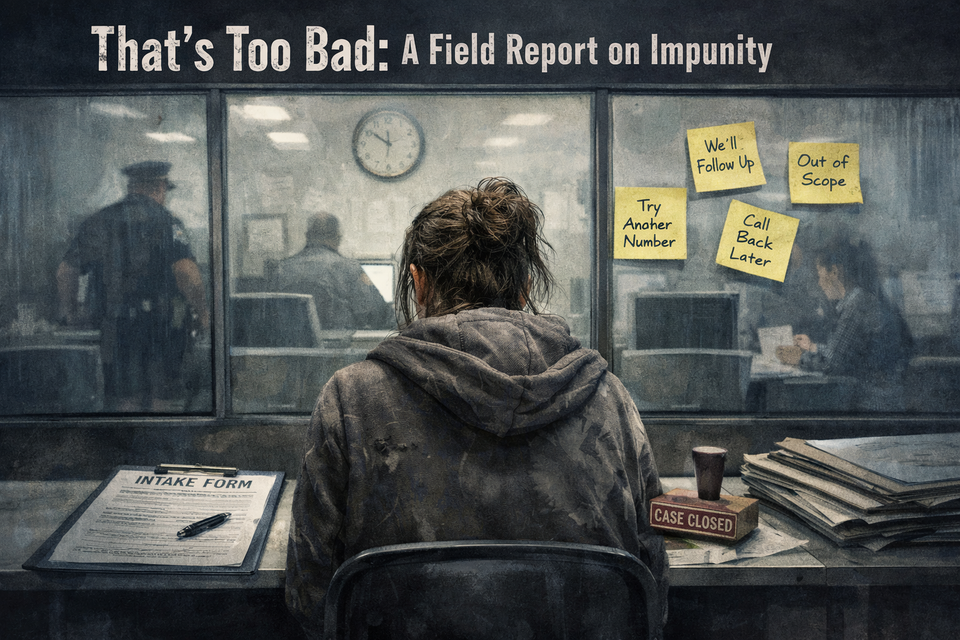
I tell nonprofit intake workers filling out forms on clipboards. Shelter staff conducting ten-minute eligibility screenings. Outreach coordinators with tablets and grant-funded scripts. Church volunteers serving coffee at folding tables. Social workers trained to triage crisis into categories. Attorneys who nod gravely and promise to “look into it.” Police officers who shift their weight and glance at their watches. Federal agencies whose websites advertise seriousness.
Once, I told a public defender who appears monthly at a church serving unhoused people. He listened. He frowned. He said:
“That’s too bad.”
That phrase is the most consistent response I receive. I usually respond to this comment with, no sir, this is not a gee, that's too bad, situation.
This is an ongoing genocide targeting women in America and being covered up.
WHAT IS FUCKING WRONG WITH YOU??? I don't say that last part generally. But. I am not the problem here. It is NOT me.
Procedural Stillness
Sometimes it comes with a sympathetic nod. Sometimes with bureaucratic fatigue disguised as realism. Sometimes with a gentle redirection back to housing paperwork or bus passes.
But the substance does not change.
That’s too bad.
No follow-up questions.
No formal documentation.
No escalation.
No referral that produces action.
No recognition that crimes of this magnitude — kidnapping, trafficking, torture, large-scale theft — trigger obligations beyond polite disengagement.
What I am documenting here is not merely personal abandonment.
It is impunity in its most procedural form.
Impunity rarely announces itself through dramatic cover-ups or overt corruption. More often, it operates through administrative stillness. Through systems that absorb extreme allegations and neutralize them through inaction — not because they are incoherent, but because responding would be expensive, jurisdictionally complex, destabilizing, or inconvenient.
It looks like this:
A disclosure is made.
It is heard.
It is not meaningfully recorded.
It is not escalated.
It is not assigned investigative authority.
It dissolves.
No confrontation. No denial. Just non-action.
The Absence of Process
I am not asking the people I speak to to adjudicate my case in real time. I am not demanding immediate intervention. I am not seeking emotional validation.
I am documenting the absence of process.
If an unhoused person reports kidnapping, trafficking, and torture, the institutional response should not be sympathy followed by a return to the housing checklist. It should be documentation. Escalation. Referral to entities with investigative authority. Recognition that certain harms exceed the scope of social services and implicate state responsibility.
Instead, I encounter a quiet consensus that some claims are simply too large to handle — and therefore must be ignored.
Not formally dismissed.
Not disproven.
Just left suspended.
This is how impunity sustains itself.
The Hierarchy of Credibility
Crimes do not go unanswered because they are unknown. They go unanswered because the person reporting them lacks leverage, status, or institutional protection.
Homelessness does not disprove an allegation. But it reliably lowers the credibility assigned to the speaker. It relocates the report into a category labeled unstable, complicated, or beyond mandate.
The result is a perverse hierarchy of credibility:
The more comprehensive the harm,
the less manageable the narrative,
the lower the institutional appetite to engage.
If someone steals your car, there is a form.
If someone kidnaps you, traffics you, extracts labor and intellectual property, dismantles your life, and leaves you without protection, the system pauses — then closes ranks through inertia.
Jurisdictional Avoidance
I have gone to the organizations that explicitly claim to address trafficking.
National hotlines.
Local anti-trafficking nonprofits.
Federally funded coalitions.
Drop-in centers advertising survivor support.
I have called. I have filled out intake forms. I have left detailed messages. I have been referred — repeatedly — to centralized hotlines, as though repetition itself were intervention.
The pattern is consistent.
A brief intake.
A shift in tone when the scope exceeds the script.
A referral elsewhere.
Silence.
Or a refusal framed as capacity limits, eligibility constraints, or “not a fit.”
In some cases, I was told assistance was available only if I were in an active trafficking situation, as though the crime ceases to matter once the immediate captivity ends. In others, I was told the organization specialized in narrower categories: minors only, labor only, domestic violence only, emergency extraction only.
I have gone to domestic violence organizations.
Family violence clinics.
Legal aid programs.
Victim advocacy groups.
Each operates within bounded mandates. Each has funding constraints. Each has liability considerations. Each has eligibility criteria.
The cumulative effect is that a person reporting kidnapping, trafficking, torture, and large-scale theft can move from office to office, hotline to hotline, without ever encountering a structure that accepts jurisdiction.
There is always another number to call.
Another intake to complete.
Another entity “better positioned” to assist.
At a certain point, repetition becomes data.
There is, effectively, a jurisdictional void.
And people without housing fall into it first.
Compassion Without Power
Occasionally, I encountered women who cared.
Women who answered the phone and did not rush me. Women who listened carefully. Women who acknowledged, quietly, that what I was describing was serious.
More than once, after I described the broader pattern of deflection, a woman on the other end of the line responded with recognition:
“Yes. I’ve seen that.”
They did not minimize. They did not reinterpret.
The pattern was not invisible to them.
Compassion without power does not interrupt impunity.
Power without accountability can distort even organizations built to prevent exploitation.
The Attempted Silencing
In Maine, I was being prosecuted on the claim that I was stalking my perpetrator. The allegation was false. It inverted victim and offender. Had that prosecution succeeded, I would have been incarcerated.
Incarceration would not merely have restricted my freedom. It would have discredited me publicly and severely limited my ability to speak or document what happened.
That would have been the cleanest way to silence me.
It did not happen.
I was given my passport. I left. I am alive. I am speaking.
The Signal Sent
If ten years of sustained disclosure — across states, institutions, and public platforms — yields no investigation, no prosecution, no restitution, what signal is being sent to perpetrators?
If I can speak continuously — across states, across institutions, across social media — for ten years and produce no meaningful escalation, what message does that send?
Impunity does not require a coordinated conspiracy.
It requires predictable non-response.
The absence of repercussion becomes information.
The Economic Question
I do not fully know why this silence persists.
But I suspect something deeper than bureaucratic fatigue.
Our economy depends heavily on unpaid labor. Underpaid labor. Emotional labor. Sexual labor. Reproductive labor. And overwhelmingly, that labor is extracted from women.
If accountability for exploitation is economically destabilizing, then avoidance becomes predictable.
Maybe that is the reason.
Maybe it is something else.
But I cannot ignore the pattern.
“This Sounds Insane.”
I am aware of how this sounds.
I look at what has happened to me — the duration of it, the scale of it, the indifference surrounding it — and I think:
This is insane. I wake up every day. This is fucking insane. And awful.
And yet it continues.
What is most destabilizing is not the allegation itself.
It is the endurance of the indifference.
Record of Notice
Silence is not always imposed through physical force. It is often produced through procedural exhaustion.
I am still here.
This is not a plea for sympathy.
It is a record of notice.
I have disclosed, repeatedly and plainly, the same account to a wide range of institutions. None of those disclosures resulted in meaningful action.
Impunity thrives not because no one knows, but because everyone knows and no one is required to act.
So I will continue telling the story.
I will continue documenting.
I will continue surviving.
Because silence is the final condition impunity requires.
And I refuse to provide it.

Comments ()