
Powerful Men Get Out-of-Jail-Free Cards. Women Never Do.
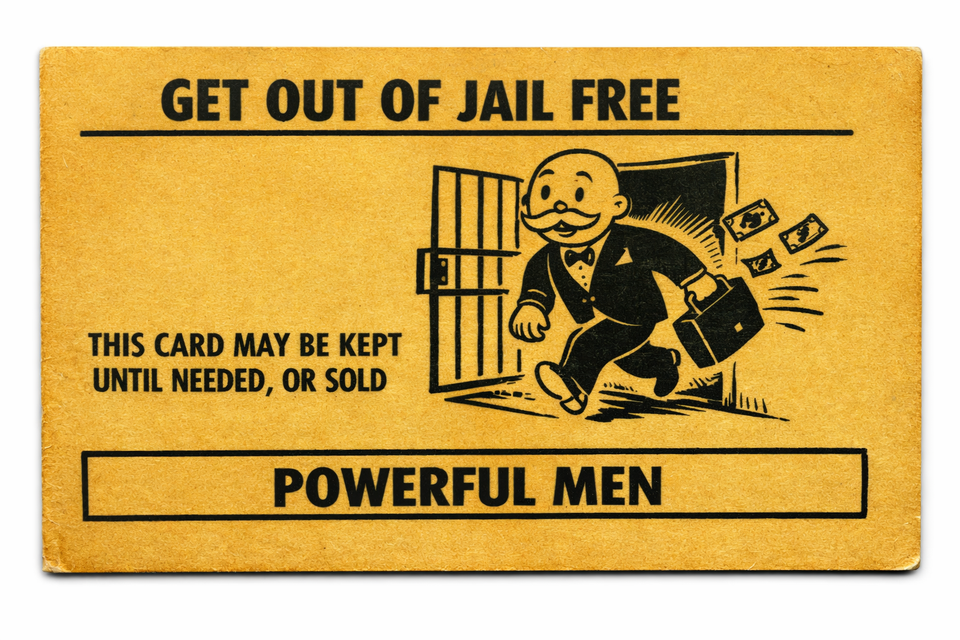
Last week, a document quietly circulated that should have set off alarms. It didn’t.
A leaked Bureau of Prisons notification revealed that Ramesh “Sunny” Balwani—the convicted Theranos executive—had been granted a six-month furlough beginning January 30.
Six months.
Out of custody. Relocating to the Santa Barbara area. No public explanation. No scrutiny. No headlines.
Balwani was convicted on all counts: conspiracy to commit wire fraud, investor fraud, and patient fraud. Seven years remain on his sentence. His projected release date is April 2033.
Furloughs are typically brief—three to seven days—and generally reserved for inmates nearing release. Not for men with nearly a decade left to serve. Not for defendants previously deemed flight risks. Not for individuals prosecutors fought to keep detained because of overseas assets and international ties.
Yet here he is, free on the California coast.
Almost no one is asking why.
We don’t even know how often this happens. There is no public accounting of how many powerful men who are officially “incarcerated” are, in practice, not in prison at all. These decisions are administrative, quiet, and largely invisible. No hearing. No public justification. No victim notification. No press release.
Unless a document leaks—as this one did—the public never knows.
There is no centralized reporting. No searchable database. No way to track who is gone, for how long, or on what grounds.
Balwani’s case may not be an exception. It may simply be one of the rare moments when the curtain slipped.
How the Discretion Works
This is not mystery. It is mechanism.
The Bureau of Prisons has broad authority to grant furloughs without judicial review. These decisions are discretionary and not subject to mandatory public reporting. Victims are not required to be notified. Prosecutors are not required to explain. There is no searchable record the public can audit.
In practice, incarceration is no longer binary. For certain defendants—those with money, connections, and institutional fluency—custody becomes flexible. Negotiable. Part-time.
Prosecutors defer to the Bureau. Courts treat furloughs as administrative matters. The press covers formal proceedings and official statements—and never sees what is not announced.
So when a man like Balwani quietly relocates while still serving a federal sentence, it barely registers.
This is not leniency by accident.
It is mercy by design—distributed through silence.
The contrast is impossible to ignore.
Elizabeth Holmes—the public face of Theranos—remains incarcerated. She was acquitted of all patient-related charges. She is the mother of two young children. Her request for a reduced sentence dominated coverage for days.
Balwani’s unexplained freedom barely registered.
This is not coincidence. It is structure.
During trial, Holmes testified under oath about the abuse she endured during her decade-long relationship with Balwani. She met him at nineteen. He was thirty-seven. She described control, surveillance, coercion, and sexual violence.
She testified that he forced sex when she did not consent. That he controlled her diet, isolated her, dictated her speech, and monitored her relentlessly. That he said he wanted to “kill the person” she was and replace her with “a new Elizabeth.”
This testimony went to the core of how power operated inside Theranos.
Balwani was widely understood to be the operational engine—running finances, imposing discipline, applying pressure.
And here is the incentive structure:
It made no sense for him to start his own company when he could position a woman out front. When he could remain the hidden authority while she absorbed the scrutiny. When, if everything collapsed, she would take the spectacle—and the punishment.
Men extract power.
Women absorb blame.
When the crime succeeds, the men profit.
When it fails, the woman falls.
This is not accidental. It is efficient. And it is reinforced every time the system stages punishment for women while quietly extending discretion to the man behind her.
The Money
Venture capital is not neutral. It is a power network—and one of the most gender-skewed institutions in American life.
Companies founded solely by women receive roughly 2–2.3% of venture capital annually.
Male-only teams receive more than 80%.
These numbers have barely moved in a decade.
This is not a pipeline problem. It is gatekeeping.
So how did Holmes raise extraordinary capital so quickly?
Seen clearly, it is not mysterious. A powerful man positions a young woman as the visionary front while signaling to other powerful men that she is manageable. A proxy. A shield.
The woman absorbs visibility.
The man retains control.
And if the enterprise collapses, the fallout lands where it was always meant to land.
I Know This Structure
I know it because I lived it.
When I founded my startup, I did not seek traditional U.S. venture capital. I went abroad, where I was seen as a Silicon Valley founder—not filtered through the credibility-eroding category of “female founder.”
The difference was immediate.
But here is what almost never gets said:
In today’s world, real power compounds through tech—through infrastructure, platforms, data, capital flows.
And when women build real power inside that system, the response is not protection.
It is containment.
I built. I accessed capital pathways meant to confer stability. What followed was annihilation.
I was drugged. Kidnapped. Transported across state lines. Held and tortured for two years.
When I escaped, institutions closed ranks—not around me, but around themselves.
The system protects the structure, not the prey.
That lesson removed any illusion I had about what happens when women accumulate unmediated power.
Containment.
Erasure.
Destruction.
The Victims Are Never Told
Victims are not notified when furloughs are granted. They cannot object. They are not told when the person convicted of defrauding or endangering them is released.
This is not oversight. It is design.
Accountability becomes a closed conversation between institutions. Victims are invoked at sentencing—and erased when discretion replaces consequence.
Administrative mercy is a second injury.
It is imposed without transparency or consent.
This Is Not Radical
It is not extremism to say crimes should have consequences. It is not ideological to insist no one is above the law.
What is radical is dissolving accountability for powerful men while staging punishment for women.
When consequences become optional for the powerful, law becomes theater.
This is not a demand for special treatment.
It is a refusal to normalize double standards.
Criminals deserve consequences.
No one is above the law.
And a society that forgets this does not remain free for long.

Comments ()