
Marriage in America Is Slavery for Women
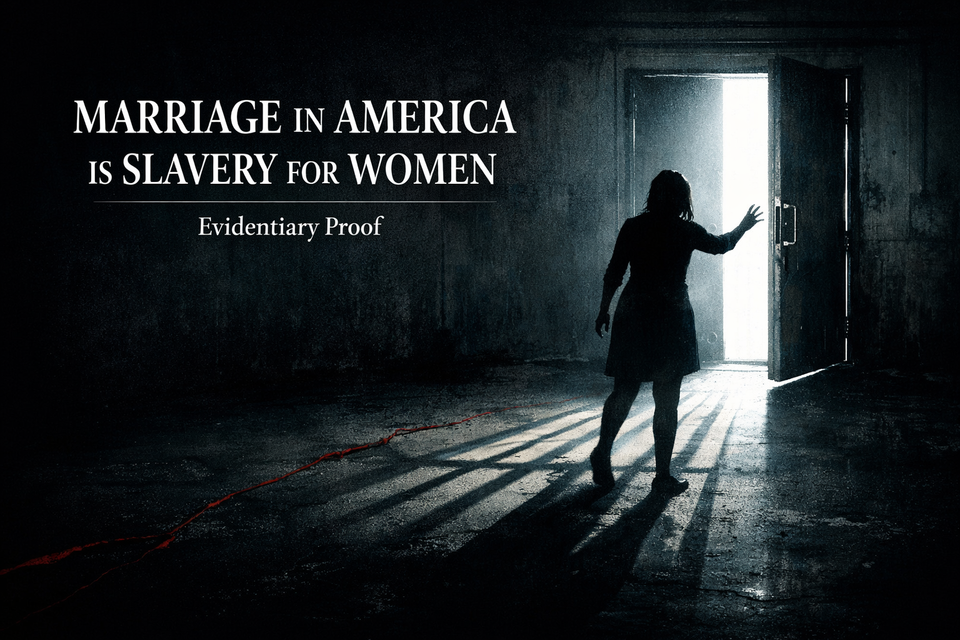
Evidentiary Proof
There is a claim so familiar it passes as common sense: marriage in America is voluntary, therefore free. If a woman is unhappy, she can leave. If she stays, it must be choice.
This claim collapses under a single, devastating fact: the moment a woman attempts to leave her husband is one of the most dangerous periods of her life. Separation is when violence escalates, stalking intensifies, and homicide risk spikes. This is not anecdotal. It is patterned, documented, and widely known.
Freedom is not proven by entry.
Freedom is proven by exit.
And in marriage, exit is routinely punished.
Exit, Not Consent, Is the Measure of Freedom
Across law, economics, and human rights, voluntary systems share one defining feature: meaningful exit without retaliation. Where exit is blocked—by force, threat, deprivation, or death—the system is coercive regardless of how it is described.
This principle is foundational. It is how courts distinguish valid contracts from duress, employment from forced labor, and migration from trafficking.
The test is simple: what happens when someone tries to leave?
In American marriage, the answer is consistent.
Women who attempt to leave face a predictable pattern:
- Escalation of physical violence
- Threats to children and pets
- Financial sabotage and housing loss
- Stalking and coercive control
- Institutional disbelief or minimization
These outcomes are not rare deviations. They are the enforcement mechanism.
The Myth of Safe Exit
The most common rebuttal is formal: divorce is legal; therefore exit exists.
This is a category error.
Exit is not meaningful if it reliably produces:
- Credible risk of death
- Loss of shelter, income, and healthcare
- Punishment through custody courts
- Exposure to further violence during separation
A choice between continued compliance and catastrophe is not consent. It is coercion by other means.
If an employer threatened lethal retaliation for quitting, no one would call that employment. If a trafficker allowed victims to “leave” but hunted them afterward, no one would call that freedom.
Marriage is insulated from this logic not by evidence, but by tradition.
Violence at Exit Is Not Accidental
Violence spikes at separation for a reason.
Leaving withdraws:
- Unpaid domestic labor
- Sexual access
- Emotional regulation
- Status and control
Exit threatens the arrangement.
The resulting violence is disciplinary. It is not about hurt feelings. It is about reasserting control when entitlement is challenged.
Systems reveal their nature at the point of rupture.
Ownership Without a Deed
Critics insist marriage cannot be compared to coercive labor systems because no one is legally owned. This confuses form with function.
Modern systems rarely rely on explicit ownership. They rely on control over labor and exit.
Marriage accomplishes this through:
- Economic dependency structured by law and policy
- Presumption of unpaid care and domestic labor
- Social and legal tolerance of coercive control
- Failure to enforce protections at separation
What is owned is not the person, but the use of her labor, backed by threat.
Ownership was not abolished.
It was privatized.
Unpaid Labor Is Slavery by Function
The function of slavery is straightforward: extraction of labor under coercion, without fair compensation, under conditions where exit is blocked or punished.
Unpaid domestic, care, emotional, and relational labor meets this definition.
Women perform work that:
- Produces economic value
- Replaces paid labor
- Stabilizes households and markets
- Enables others’ productivity and wealth
Yet this labor is:
- Uncompensated
- Uncredited
- Excluded from legal protection
- Framed as natural obligation
Refusal results in punishment: abandonment, poverty, violence, loss of children, social exile.
Calling this “unpaid labor” is not neutrality.
It is euphemism.
Enforcement by Omission
This regime persists not because violence is legal, but because it is selectively unenforced.
Protective orders are ignored. Threats are minimized. Economic abuse is dismissed as private conflict. Women are told to work it out.
Non-enforcement is not neutrality.
It is permission.
When the state fails to protect women at exit—despite knowing that exit is the point of greatest danger—it enforces the arrangement by omission.
Family Court as Enforcement Mechanism
The most effective way to prevent exit is not always physical force.
It is the credible threat of losing one’s children.
Family court frequently becomes the site where attempted exit is punished. Women who allege abuse during separation are reframed as “high conflict,” “alienating,” or unstable. Protective action is pathologized. Documentation is minimized.
The message is clear:
Leave, and you may lose your children.
Custody litigation becomes a tool of post-separation coercive control. Repeated motions drain resources. Court-ordered exchanges create continued access. Litigation itself becomes the weapon.
Children become leverage.
When raising abuse allegations increases the risk of custody loss, the state is not neutral. It is participating in coercion.
Hostage Logic
Control over children functions as hostage-taking in everything but name.
The mechanism works because it does not need to be universal. It only needs to be credible.
Many women stay not because they consent — but because they calculate.
Exit becomes a gamble with their children’s lives.
In this structure:
- Alleging violence can trigger retaliatory custody claims
- Seeking protection can be reframed as instability
- Financial exhaustion weakens a mother’s legal standing
- Shared custody mandates ongoing contact
This is enforcement by procedure.
When Children Become Targets
In some cases, the violence escalates further.
Children themselves become targets.
There is a documented pattern in certain separation and custody conflicts in which fathers harm, terrorize, or kill their children in order to punish or retaliate against the mother. Criminologists describe this as retaliatory or revenge filicide — violence directed at children as an extension of coercive control.
The logic is instrumental.
When control over the woman is threatened, harm shifts to what she values most.
These acts are often preceded by threats to “take the children,” escalating custody disputes, and assertions of ownership over access and authority.
The killing or torture of a child in this context is not random. It is an extreme expression of entitlement logic.
Separation is already the period of highest lethality for women. In a subset of cases, children are killed during or after custody conflicts precisely because harming them guarantees permanent punishment of the mother.
This is violence by proxy.
The most brutal form of leverage available.
Structural Meaning
When a system:
- Dismisses maternal reports of danger
- Forces ongoing contact through custody orders
- Preserves paternal access despite escalating risk
- Penalizes women for naming abuse
it creates conditions in which retaliatory violence becomes foreseeable.
Not inevitable.
But foreseeable.
And foreseeable risk that goes unmitigated is not neutrality.
It is complicity.
Intergenerational Capture
The consequences do not stop with one woman.
Children inherit:
- Economic instability
- Normalized coercion
- Gendered labor expectations
- Trauma framed as family life
Daughters learn that care is obligation.
Sons learn that care is owed.
The labor regime reproduces itself quietly.
Why This Cannot Be Named
If unpaid labor were recognized as forced labor:
- Marriage would require compensation
- Exit would require real protection
- Courts would prioritize safety over access
- The economy would account for extraction
Instead, the system insists:
This is love.
This is choice.
This is private.
These are not descriptions.
They are defenses.
Freedom That Requires Silence Is Not Freedom
A system in which:
- Leaving increases homicide risk
- Reporting abuse increases custody risk
- Seeking protection increases financial ruin
is not voluntary.
The work exists.
The violence enforces it.
Children are used as leverage.
The state looks away.
That is not freedom.
That is a coercive labor regime sustained by denial, procedure, and brutality.

Comments ()