
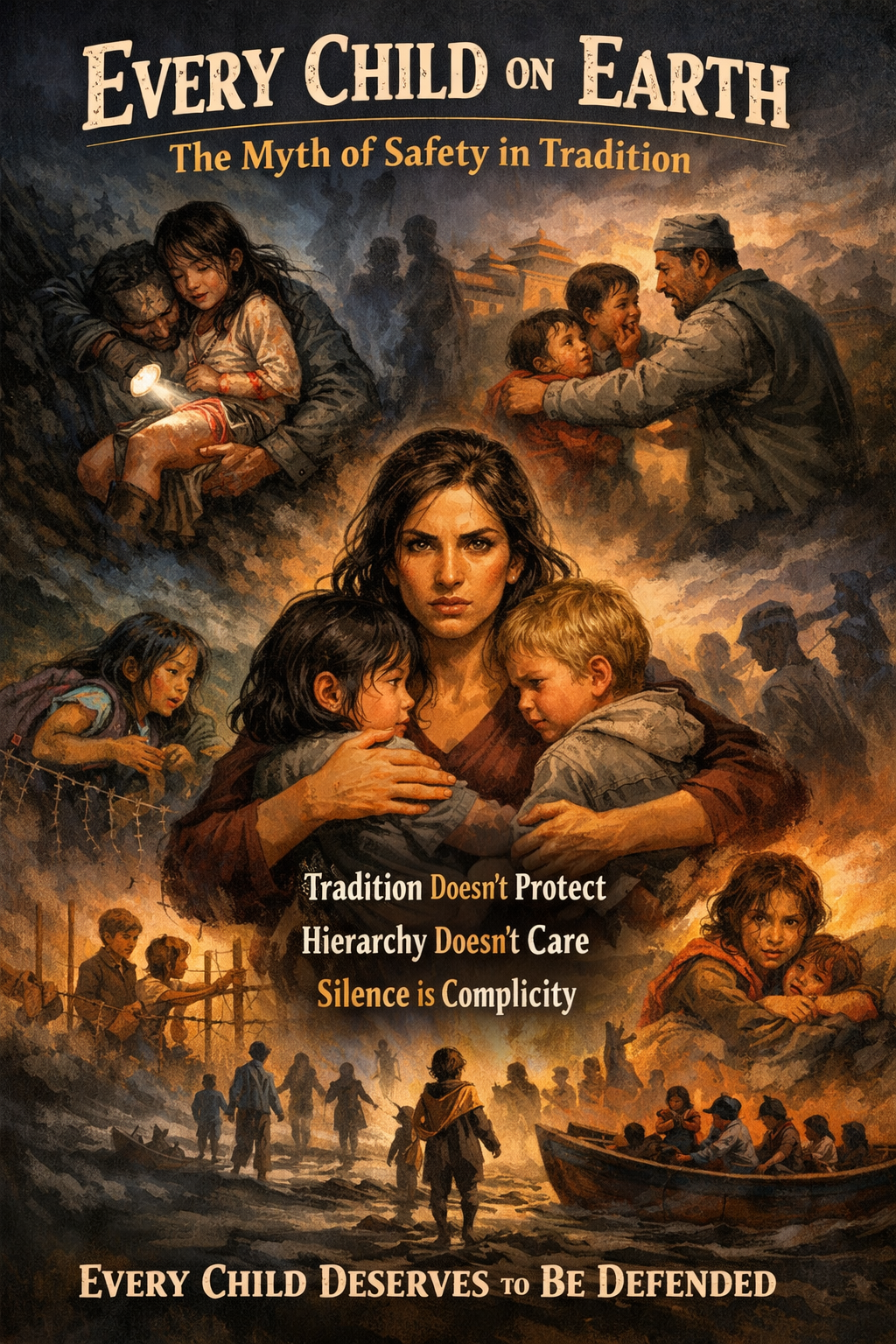
Every Child on Earth
I used to believe the story.
The story that traditional societies are kinder. More grounded. That before modernity, before feminism, before the “breakdown of the nuclear family,” people naturally protected one another.
I carried that myth. And then it shattered.
Bhutan
The first time was in Bhutan, on my honeymoon. The country had just opened to Western tourists. The villages were breathtaking: terraces of green spilling down mountainsides, smoke curling from clay stoves, sunlight glinting off streams like liquid silver. Faces were polite, calm, patient. Everything seemed to confirm the fantasy: here was a civilization intact, untouched, gentle.
We walked for hours off the road, along narrow, rocky paths through forests scented with pine and wet earth. The guides began preparing dinner as dusk fell, and I wandered toward the laughter of children.
They ran to me, arms flailing, dogs weaving through their legs, barking. I laughed, I played, the air alive with life.
Then fear cut through it. Children grabbed my hands, tugged at my sleeves, eyes wide. They pointed to a little girl and a dog.
“Did the dog bite you?” I asked. She wouldn’t answer.
One child whispered, “She’s embarrassed.”
Embarrassed.
I knelt down. “Show me,” I said. She hesitated, then lifted her dress.
The dog had ripped a chunk from her inner thigh. Blood gushed, dark and hot against the cool mountain air. She was barely five, and she was bleeding out right in front of me.
I ran to the guides. “Take her to the nearest hospital. Now. She will die if you wait.”
They hesitated. She was the lowest-status child in the village. Her parents were away. The path was dark, the night swallowing the trail. Hierarchy had spoken: she was expendable.
I lost my temper. I said I did not care about tradition, hierarchy, or fear. She would eat first, then be taken for medical care. I would pay. I gave the guide a flashlight. He carried her into the dark, arms trembling under her weight.
Later, I learned part of their hesitation had nothing to do with the path or the darkness itself. They were afraid of demons. The men who could carry her to safety believed the night was dangerous, haunted by unseen forces that could strike them if they traveled after dusk. That is why I handed them the flashlight. Not just to see the trail—but to fight off what they feared. At the time, I thought it was absurd. Demons? This child could die. Move.
Years later, watching social media fill with religious certainty, especially among evangelical Christians, I see how common this belief still is. Many people genuinely believe demons walk among us, that spiritual evil is the true threat. What they miss is this: the real danger is not supernatural. The real demons are men. Men shielded by patriarchy. Men protected by tradition, religion, and authority. Men taught that harming women is love, that control is care, that violence carries no consequence. Those are the demons that tear children from their mothers’ arms. Those are the demons that leave girls bleeding on mountain paths. Those are the demons we should fear.
I never learned what happened next.
But I learned something vital that night: beauty and ritual do not guarantee care. Hierarchy often decides whose life matters. Tradition can be indifferent. Even cruel.
Confronting the Myth
Through the years after Bhutan, I noticed something remarkable. Conversations about parenting, society, family—people kept saying the same thing: nuclear families are failing, modern families are weak, primitive families are better.
Every time, I would say, “No. You need to hear this story.”
And every time, I marveled at how deeply people cling to this fantasy. Primitive families are not inherently better. Tradition does not automatically protect. Hierarchy does not guarantee safety. They believe it anyway.
I don’t. I’ve seen too much. Children left to bleed. Devotion powerless against authority. Love colliding with hierarchy and losing. The fantasy persists. But it’s false.
Dekhi
Years later, closer to home, I encountered the myth again. After the birth of my first child, I hired a Nepalese nanny named Dekhi. Soft-spoken, intelligent, utterly devoted. She cared for her own newborn son and mine with the same steady attention, the same quiet, unwavering love. Every gesture—rocking, feeding, watching, listening—was deliberate, full of presence, as if an invisible thread connected her to both children at once. Her face glowed with patience and fierce tenderness, even when exhaustion tugged at her eyes.
She took her son to Nepal to visit family. When she returned, she came back without him. Her father, worried about his “safety,” had forced her to leave him behind. The grief on her face was quiet, immense, almost physical. I was stunned. Powerless to fix what authority had taken.
Years later, at a Nepalese gathering, I saw them again. Her son, four, was a storm: rage, mistrust, chaos. Every glance, every flail, every sudden scream spoke of a child torn from the arms that loved him. The wound of hierarchy and patriarchy was etched in his body.
Love alone had not protected him. Devotion alone had not protected him. Authority had claimed him. Tradition had failed him.
Two moments. Two countries. Two cultures. Same lesson: traditional families, traditional societies, rigid hierarchies—they do not inherently protect. Safety, care, love—they are choices. And when those choices are withheld, children bleed. Children rage.
I had believed in the myth. That beauty, ritual, tradition, and family could stand in for protection. I was wrong.
Protection is not inherited. Compassion is not guaranteed. Safety must be actively chosen.
Closing Reflection
Every child on earth feels like my child. I think all good mothers feel this. That instinct to protect, to defend, to refuse to let harm touch them—that is primal, unshakable.
We cannot allow these broken, hateful men to hurt us or our children any longer. Not because tradition promises it, not because hierarchy says it, not because someone in authority claims it. Protection, love, safety—they are ours to demand, ours to enact, ours to choose.
Every child deserves a witness. Every child deserves a defender. Every child deserves a mother who refuses to look away—who will fight to the death
for their opportunity for a good life



Comments ()