
Don’t Be the Bunny: Bathrooms, Power, and the Lie We’re Living In
Editor’s Note:
Horrific violence against women is happening every day in ordinary neighborhoods across America. Much of it occurs behind closed doors, is never reported, and is never covered. Women in danger are often isolated, disbelieved, or forced into silence while they are still trying to survive. The experiences included in this essay are shared not because they are unusual, but because they are common—and because this reality remains largely unacknowledged.
I know someone—an acquaintance—who wrote Urinetown. It’s one of my favorites. It’s clever, quirky, breaks the fourth wall beautifully—but mostly, it’s honest.
Urinetown is satire that doesn’t age well. The closer reality gets to it, the less funny it becomes.
If you haven’t seen it, Urinetown is about a society where people have to pay to use the bathroom. Break the rules, and you’re punished. The premise sounds absurd—until you realize how familiar it feels.
Because we are living in Urinetown now.
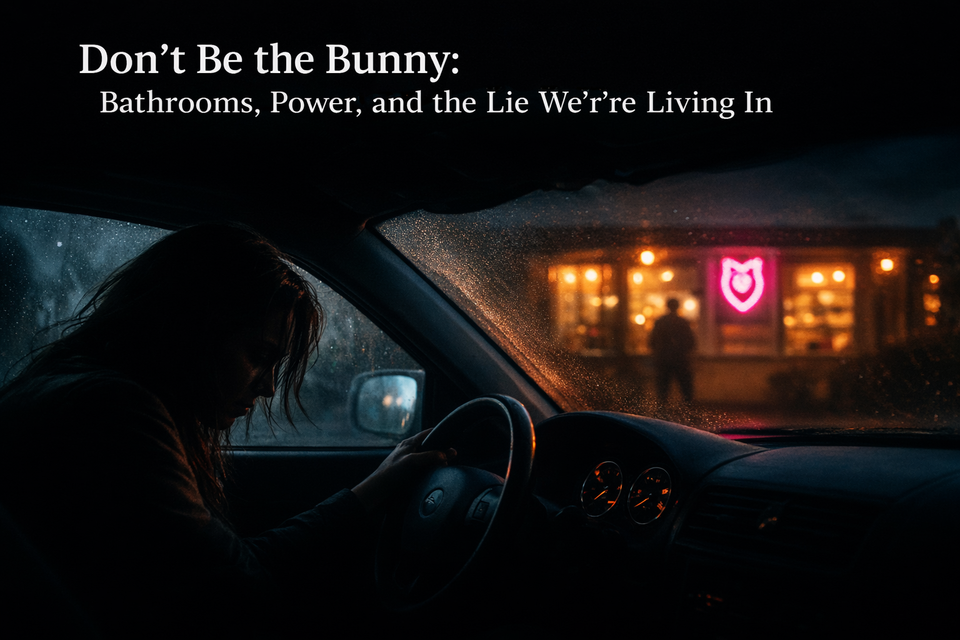
The other day, I was sitting in Pink Owl Coffee. A normal café. Coffee, pastries, young women behind the counter. I was drinking a coffee from that café. Someone else had bought it for me.
When I asked for the bathroom code, they refused to give it to me.
Why? Because I hadn’t personally purchased the coffee.
I was a customer—consuming their product, occupying their space—but because the transaction hadn’t been executed by my own hand, I wasn’t entitled to relieve myself.
This wasn’t delivered cruelly. That’s the point. It was polite. Apologetic. Rehearsed. The tone of someone trained to say: I don’t make the rules. I just enforce them.
Behind the counter, playing softly over the speakers, was Let It Be by The Beatles.
The dissonance was almost surreal. When I find myself in times of trouble… drifting through the air as a woman is told that access to a bathroom depends on the technicalities of a purchase. Cruelty rendered ambient. Injustice with a soundtrack.
This is how systems rot—not through obvious villains, but through compliance. Through ordinary people cooperating with rules that strip dignity from others. Through young women—underpaid, precarious, likely drowning in rent anxiety and debt—being trained to act as gatekeepers for a system that will never protect them.
People love to call this late-stage capitalism. That framing is lazy. Capitalism didn’t invent this dynamic.
Patriarchy did.
Patriarchy is a hierarchy-maintenance system. It teaches obedience downward and cruelty upward. It trains people—especially women—to believe their safety lies in enforcing rules made by powerful men rather than questioning them. It rewards compliance, punishes empathy, and calls it realism.
Urinetown understands this perfectly. That’s why the most important song in the show isn’t about toilets at all. It’s “Don’t Be the Bunny.”
In the song, the villain explains the world to his daughter—not with morality, but with instruction. He tells her a story about a bunny—sweet, harmless, unaware—who is noticed, targeted, and killed.
Then comes the lesson:
Don’t be the bunny.
Don’t be the stew.
When his daughter objects—But Daddy, we’re talking about people, not animals—he answers with the ideology beneath it all:
People are animals, Hope dear.
That’s patriarchy speaking. The reduction of human beings to prey. The insistence that cruelty is realism and compassion is childishness.
Later, the bunny is short fifty cents at a toll booth. He didn’t plan ahead. He begs.
He begs for mercy, but gets jail instead.
By the end, the moral is explicit:
Step on the poor.
Don’t be the bunny.
This is not satire drifting into fantasy. This is instruction. This is how power reproduces itself—by teaching the next generation that survival requires alignment with dominance. That if you don’t want to be prey, you must learn how to participate.
A Smaller, Quieter Example
About a year earlier, I encountered the same logic in a less theatrical form.
At the time, I was trapped in government housing with a man who had already raped me and was stalking me. He threatened me with knives. I was in immediate danger and trying to get to my family. I had almost no money and nowhere safe to go.
In desperation, I rented a car through Zipcar with most of what I had left and drove to San Rafael to ask someone I knew—someone who had previously supported women’s causes—for help. I knocked on his door, terrified, asking for assistance getting to my family.
He shouted at me. Told me I was imagining the danger. Threatened to call the police if I didn’t leave.
I slept in the car that night. It was cold. I was out of time.
In the morning, as I sat outside that same café, the owner confronted me. Asked what I was doing there. Accused me—without cause—of stealing the car. Threatened to call the police.
A woman alone. Clearly distressed. No curiosity. No concern. Only enforcement.
This is what happens before women disappear. Before they’re killed. Before their stories are considered tragic instead of inconvenient.
Standing in that café months later, denied a bathroom code while “Let It Be” played softly, I watched Cladwell’s lesson enacted in real time. Women enforcing rules that humiliate others—and ultimately themselves—because patriarchy has taught them this is how you stay safe. This is how you keep your job. This is how you avoid being the bunny.
But here’s the lie at the heart of that lesson:
Becoming the predator does not free you. It just recruits you.
The system still eats you. It always does.
Charging people to pee isn’t about sanitation. Bathroom codes aren’t about cleanliness. They’re about control. About sorting. About who belongs and who doesn’t. About training workers to police access on behalf of people who will never be denied a bathroom in their lives.
No one should be cooperating with a system that is obliterating them.
That doesn’t make you radical. It makes you lucid.
Because the moment you accept that dignity is conditional—transactional, revocable—you’ve already agreed to far worse. You’ve already accepted Cladwell’s worldview: predator or prey.
But those are not the only choices.
If patriarchy tells us not to be the bunny, then the real act of resistance is refusing to be the butcher.
Refusing to enforce stupid, dehumanizing rules.
Refusing to pass cruelty downstream.
Refusing to sing along while it happens.
This is not something we should let be.
And no amount of soft music can make it okay.

Comments ()