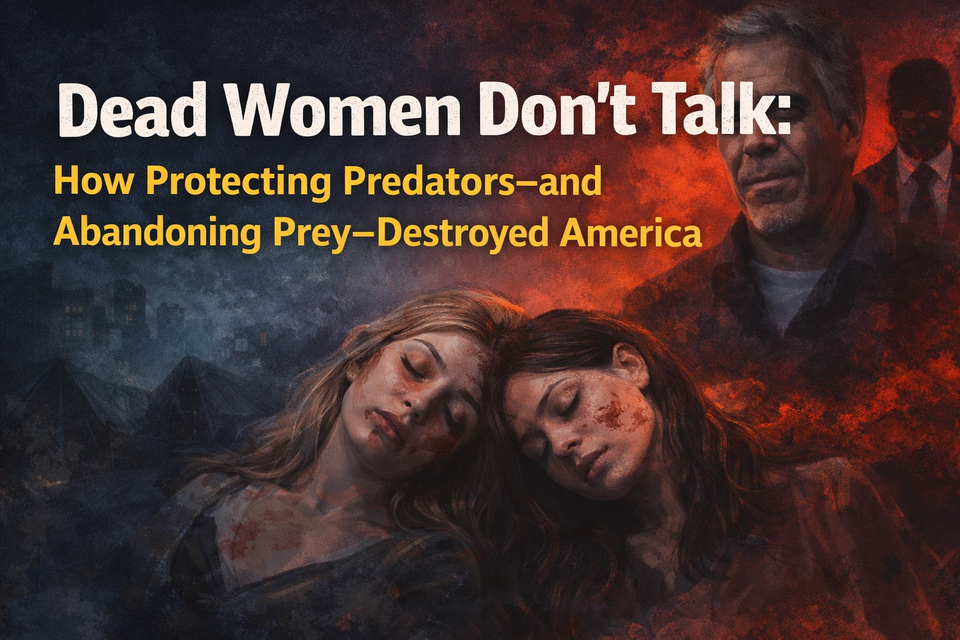
Dead Women Don’t Talk: What the Epstein Case Really Teaches. How Protecting Predators—and Abandoning Prey—Destroyed America
What happened in the Epstein network is not a scandal. It is not an anomaly.
It is sex slavery—operating openly inside the United States.
That matters because sex slavery is not separate from how this country functions. It is the most extreme and clarifying expression of the same system the American economy relies on every day: women’s unpaid labor, underpaid labor, coerced labor, and sexual access enforced through threat, dependency, and impunity.
Girls and young women are recruited, controlled, and repeatedly used for sex by powerful men. They are treated as property. Calling this “abuse” instead of slavery is not neutral language—it is concealment.
The real question is not how this happens.
The real question is why, after it happens, the logical conclusion is almost entirely absent from public discourse.
Impunity Is the System
In the United States, women and girls are turned into sex slaves with little risk to the men who exploit them—so long as those men operate within systems of protection.
Wealth.
Status.
Institutional reluctance.
Delay.
Disbelief.
Jurisdictional fragmentation.
When those shields exist, the law stops functioning as a boundary.
This is not a failure of individual morality.
It is structural permission.
When rape is not investigated, trafficking is not prosecuted, disappearances are not urgently pursued, and the deaths of exploited women are quietly closed, violence becomes low-risk.
Harm is no longer constrained by justice. It is constrained only by access to impunity.
As long as a woman is alive, she can speak. Survival itself threatens the system. That is why sex slavery depends on isolation and silencing—and why disappearances and deaths so often end scrutiny instead of triggering it.
For men operating with impunity, the Epstein survivors prove a simple fact:
Living women talk. Dead women don’t.
This is not a moral claim. It is a description of how risk is managed when the law does not function.
At the same time, many women who defend themselves are jailed. This is not a contradiction. It is the same logic at work. The system is far more willing to punish women who resist violence than to prosecute men who benefit from it.
A Contemporary Case, Not a Historical One
This is not a historical problem. It is present tense.
I am a former tech executive. I built the beta of a platform valued in the billions. While seeking funding in South Africa, I was abducted, transported back to the United States, and held in a small town in Maine for two and a half years as a sex slave. I escaped in 2019.
Since then, I have reported what happened. I have asked for investigation. I have asked for protection.
I have been ignored.
No charges.
No inquiry.
No accountability.
My case is not exceptional because it is extreme. It is clarifying because it follows the same pattern as the Epstein survivors: trafficking enabled by silence, survival treated as inconvenience, and non-enforcement functioning as policy.
The system does not fail to see women like me.
It sees us—and declines to act.
The Silence Is the Evidence
If the Epstein case means what it logically means, this argument would be everywhere.
It would fill op-ed pages.
It would drive panels and investigations.
It would force a national conversation about what it means when sex slavery operates openly inside the United States and is protected by non-enforcement.
Instead, there is silence.
The facts are known. The pattern is documented. The conclusion is obvious. Its absence from mainstream media is not confusion—it is enforcement.
Naming sex slavery as structural threatens institutions, reputations, and the economic order itself. So the conclusion is managed by omission.
Women who state this plainly are dismissed, deplatformed, throttled, or quietly excluded—not because the argument is unclear, but because repeating it carries institutional risk.
A society that cannot tolerate naming the structure that sustains it is not ignorant of the truth.
It is invested in not saying it out loud.
What We Are Paying For
None of this happens without the state.
We pay police who decline to investigate rape.
We pay prosecutors who refuse trafficking cases.
We pay courts that jail women for defending themselves.
We pay systems that lose files and quietly close cases when women disappear or die.
These are not failures. They are choices—funded by our tax dollars.
When women express fear, we are offered anxiety studies and pharmaceuticals instead of protection. But fear is not the pathology.
Fear is the rational response to a system that does not enforce consequences.
A society that does not protect women does not merely tolerate slavery.
It depends on it.
Protection is not rhetoric.
It is enforcement.
And right now, we are paying for its absence.

Comments ()