Bread and Circuses While People Are Dying: America’s Priorities at the Super Bowl
Introduction: Bread, Circuses, and the Management of Attention
The phrase “bread and circuses” comes from ancient Rome—panem et circenses—a governing strategy that kept populations docile through spectacle and just enough material relief to prevent revolt while injustice continued unchallenged. Long before Rome, Greek festivals and games performed a similar function: civic pageantry onstage, suffering offstage. This was not entertainment as leisure; it was politics by optics. Empires learned that when legitimacy frays and inequality sharpens, attention must be managed. Spectacle expands. Discomfort is hidden. Today’s Super Bowl—and the clearing of San Francisco’s streets so tourists won’t see homelessness—are contemporary expressions of that same imperial logic: control through visibility, distraction through joy, and the quiet continuation of harm beyond the frame.
Bread and Circuses While People Are Dying: America’s Priorities at the Super Bowl
Here we are in America. The Super Bowl is here. Stadium lights blaze. Billions of dollars move effortlessly through advertising buys, security details, celebrity appearances, corporate branding, and wall‑to‑wall media coverage. For days—weeks—the country’s attention narrows to a game.
And meanwhile, women are dying.
Not metaphorically. Literally.
What’s important to say clearly—because the minimization is part of the harm—is that we do not actually know the full number of women harmed or killed by male violence in this country. We never have. What we do know is that the number is not small. It is not rare. It is not exceptional.
It is large.
Well into the millions of women are living with violence, coercion, threat, and abuse. Over time—across years and generations—that number likely reaches into the tens or even hundreds of millions of affected lives. Many never report. Many cannot report. Many are disbelieved, buried in paperwork, lost in court systems, or silenced by fear, poverty, retaliation, or shame imposed from the outside.
The official numbers we see are not the truth. They are the floor.
Every day, women are beaten, terrorized, stalked, raped, and killed—often by men known to them, often in private spaces, often after warning signs were ignored. And yet this reality remains background noise in the public conversation, while entertainment is treated as a national emergency.
This is what “bread and circuses” looks like in modern America: suffering managed, hidden, and displaced so business can proceed uninterrupted.
Bread and Circuses: A Historical Technology of Control
“Bread and circuses” is not a metaphor pulled out of thin air. It is a governing strategy.
In ancient Rome, panem et circenses described a deliberate policy: keep the population fed just enough to survive and entertained enough not to revolt. Public games, spectacles, and festivals were not side dishes to politics—they were politics. They absorbed attention, produced loyalty, redirected anger, and transformed structural violence into background noise.
Greece understood the same mechanism earlier, though in a different register. Festivals, games, and civic spectacles bound identity and loyalty to the polis, while enslaved people, women, and outsiders bore the hidden costs. Participation and pageantry masked exclusion. The story of the city was told on stage; the suffering that sustained it happened offstage.
This pattern repeats across empires: when inequality sharpens and legitimacy frays, spectacle expands. When people begin to notice who is being harmed, power answers not with justice but with distraction, ritual, and managed joy.
That is why this is not accidental. It is narrative warfare.
Narrative warfare is not just about what is said—it is about what is made visible, what is made exciting, and what is rendered ignorable. It floods the public sphere with emotion, noise, and trivia so that systemic harm feels distant, abstract, or inevitable.
Modern America has perfected this. We do not need coliseums; we have screens. We do not need emperors; we have brands. We do not need public executions; we have slow, private suffering that never interrupts the broadcast.
The function is the same: keep people focused on the spectacle while violence continues unchallenged.
And the more urgent the suffering becomes, the louder the spectacle gets.
We can mobilize unlimited attention, money, and coordination for a football game. We can guarantee perfect lighting, flawless sound, instant replay, and nonstop commentary. We can debate statistics on the field down to the decimal point.
But when it comes to violence against women?
We plead complexity. We plead uncertainty. We plead patience. We plead due process only when it protects perpetrators. We plead ignorance when the bodies pile up.
This isn’t about banning joy or canceling sports. It’s about proportion. It’s about priority. It’s about the moral disconnect required to treat a televised spectacle as sacred while women’s lives are treated as expendable, inconvenient, or invisible.
A society reveals its values not by what it claims to care about, but by what it funds, broadcasts, amplifies, and protects.
So yes—here we are. America. The Super Bowl. The halftime show. The commercials. The cheers.
And somewhere, at the same time, a woman is being hurt.
That should haunt us.
It should disrupt us.
And it should force a question we keep refusing to ask: what would it look like if women’s lives mattered as much as our entertainment?
San Francisco: Clearing the Streets for the Spectacle
Here in San Francisco, the hypocrisy is visible on the ground.
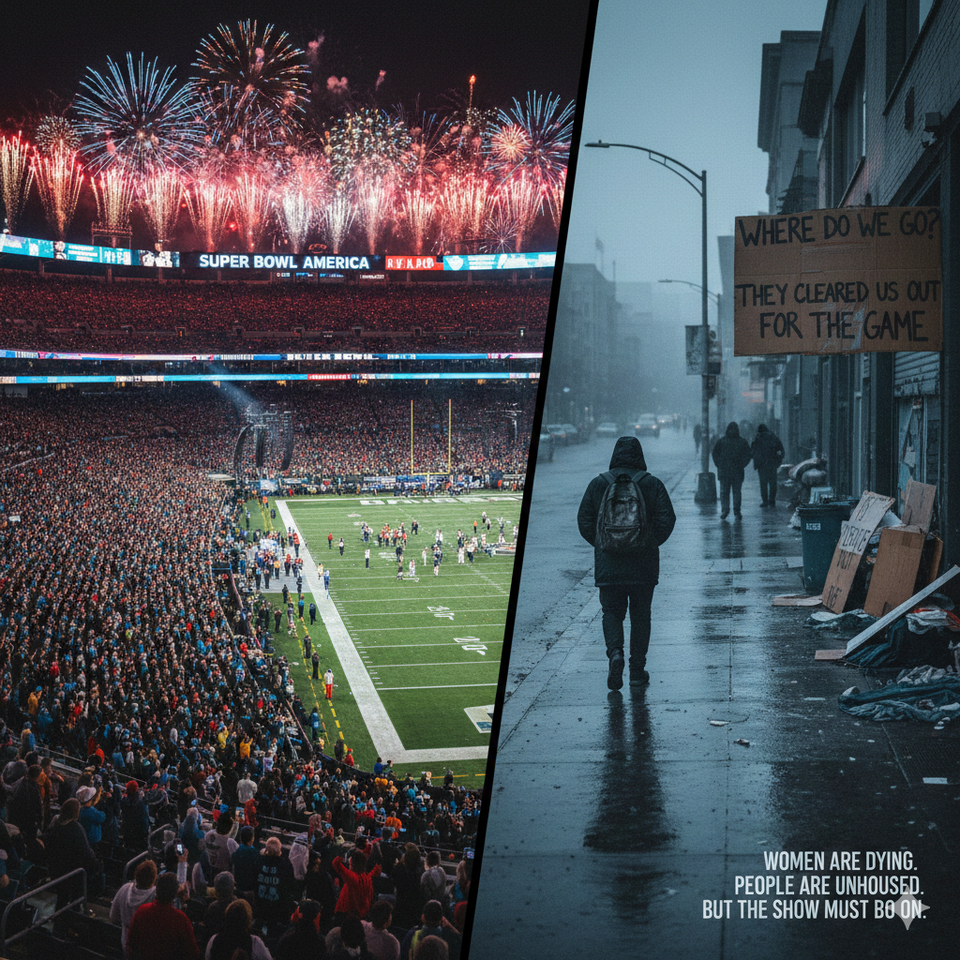
For the past week, in anticipation of incoming tourists because the Super Bowl is in the vicinity, police have been clearing the streets—the usual places where unhoused people exist because they have nowhere else to go. Sweeps. Displacement. Pressure. Movement orders.
In fact, the city even opened temporary shelters, not because of a sudden moral awakening about homelessness, but to make sure tourists don’t have to see it.
Let that land.
The resources exist. The coordination exists. The capacity exists. As I have already laid out elsewhere, we could end homelessness quickly if we chose to. Not someday. Not after endless studies. Now.
But instead of solving the problem, the city chose to hide it.
Money, time, and labor were mobilized—not to house people permanently, not to provide stability, not to address root causes—but to remove human beings from sight so visitors can enjoy a clean, curated version of the city.
This is the same moral pattern.
When there is a spectacle, we act with urgency. When there are human beings suffering, we suddenly discover excuses.
Women are dying. People are unhoused. And yet, the fastest response we ever see is when discomfort might interfere with entertainment.
That is not a failure of capacity.
It is a system working exactly as designed—to protect comfort, profit, and reputation.
It is a failure of will.

Comments ()